- [Aug 2020 – Present]
Observations about higher-altitude wind:
- It’s way stronger than ground-level wind: while the ground was a light breeze at ~5mph, the kites were very stably airborne
- It’s ridiculously (and cheaply) accessible by kite: by putting a self-sustaining kite in strong wind conditions of higher winds, there should be some way to harness it into electricity.
1. Generator
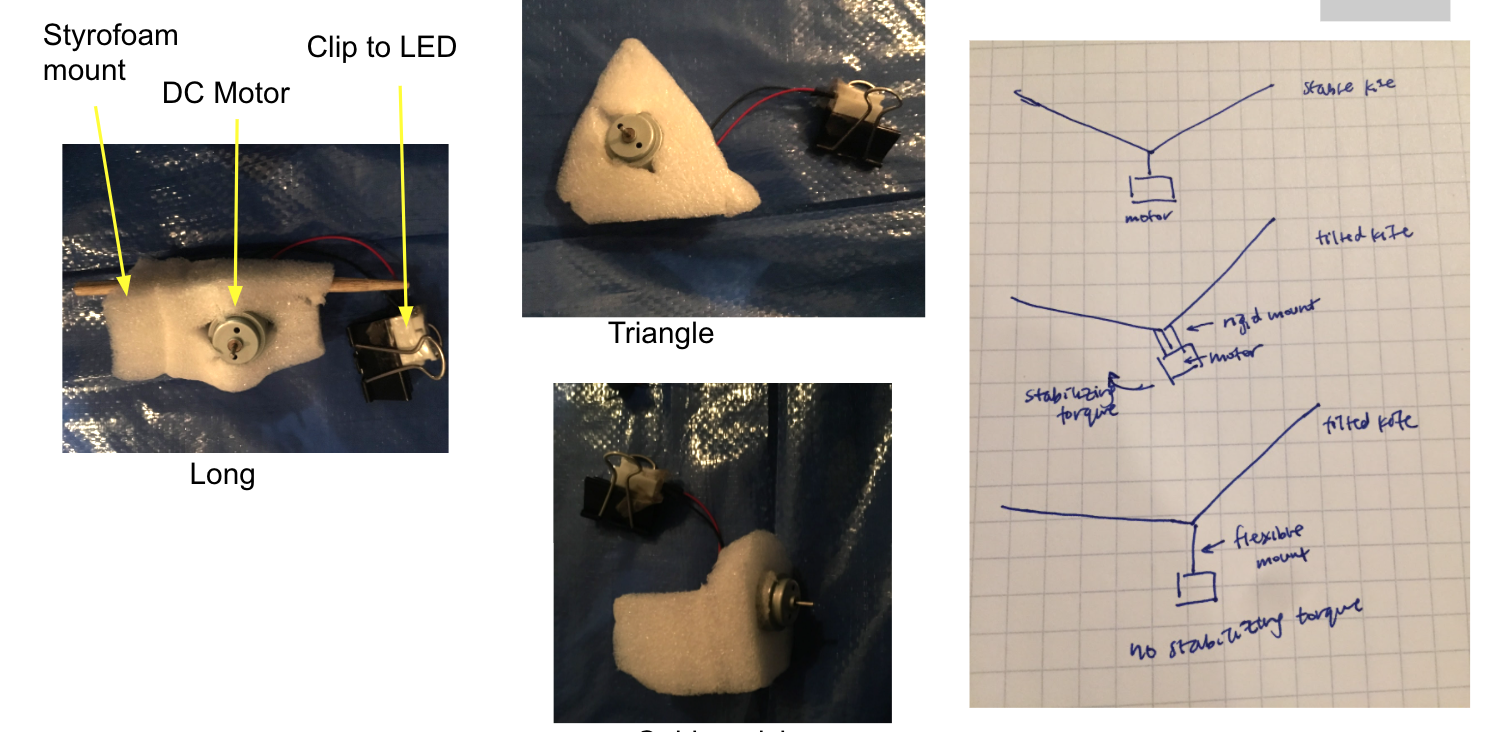
The generator just consists of a DC motor connected to the lightbulb (for proof-of-concept). I salvaged a turbine from a small fan and secured it onto the DC motor.
Challenge: attach the motor stably to the kite, yet still leaving room for it to be easily-adjusted to balance at the kite’s center of mass.
First attempt: wrap the motor tightly in a rubber band, then sew it onto the kite. This was very unstable, since the turbine was so loose that it didn’t always face the wind direction, and was also difficult to adjust once sewn on.
Diagnose: when using a flexible mount method like sewing, the generator mass doesn’t provide a stabling torque as would be with a rigid mount (see right diagram below).
Solution: plastic foam + wood stick + metal clamps. I tested 3 different designs (creatively named “triangle”, “long”, and “ooblong”).
2. Prototype
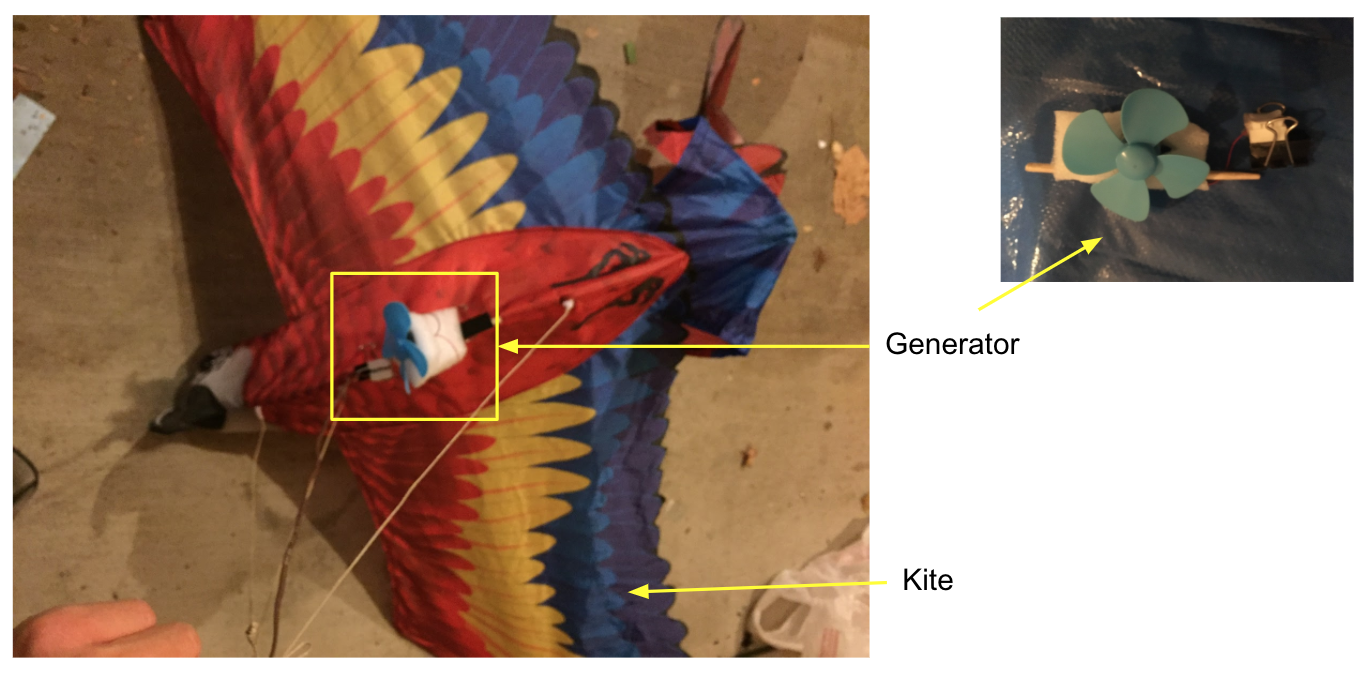
I salvaged an old kite from my garage, and simply clipped the already-made component to it.
3. Testing
My first step was to learn how to fly a kite. It turns out that kite-flying is its entirely own art, even getting the structure onto the air in itself, especially in the fair California summer breezes.
A couple of hours later, I finally got the kite + turbine conglomerate airborne.
Here’s it looked like (ground level wind was ~4mph):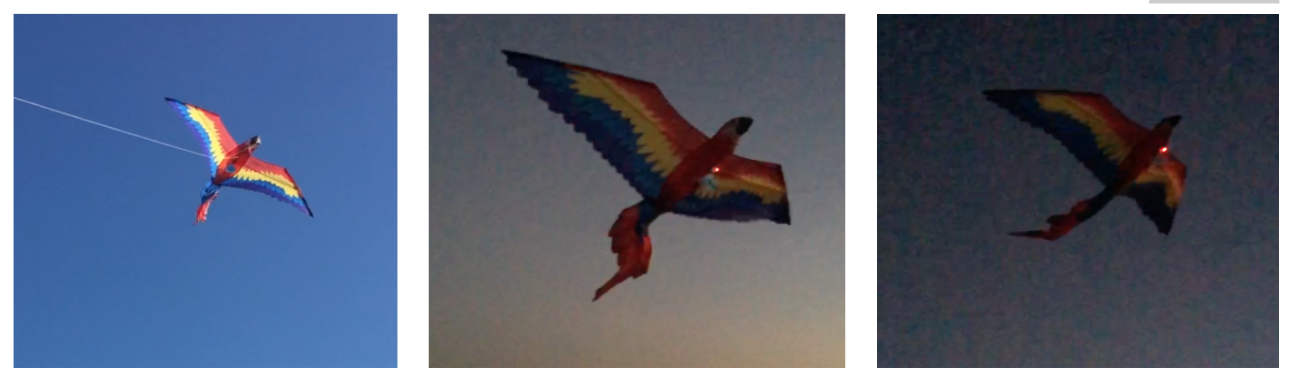
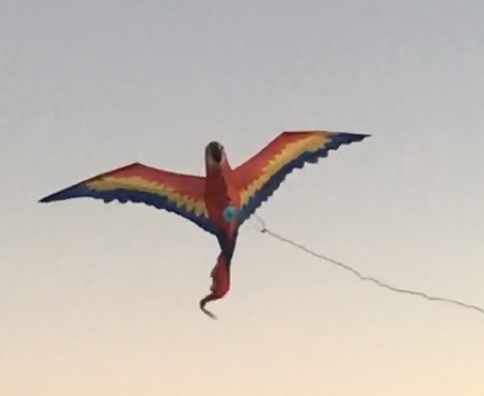
The 3-Volt LED light is primarily used as an indicator, to visualize how many volts were being generated by the turbine. It consistently lit up to maximum brightness, and [please bear with me through the wishy-washiness] based qualitatively, it appeared that the turbine speed would be sufficient to generate 6-7 Volts.
The hardest part of the project is probably finding a way to direct the electricity down to the ground, which I haven’t figured out as of yet. Brute-forcing by using an insulated wire didn’t work very well, since it was became heavy to self-sustain for very long (dark brown = insulated wire).
What’s next:
- Find a way to direct electricity to the ground well
- Design improvements
4. Reflection & A better design?
I initially actually bought a stunt kite for this experiment. Only later, I realized that these kites require way more wind, so I exchanged it with the bird kite. I recently read the Lloyd 1979 paper on crosswind kite power, and realized that stunt kites could be useful for the precisely-manipulatable paths needed for that setup.
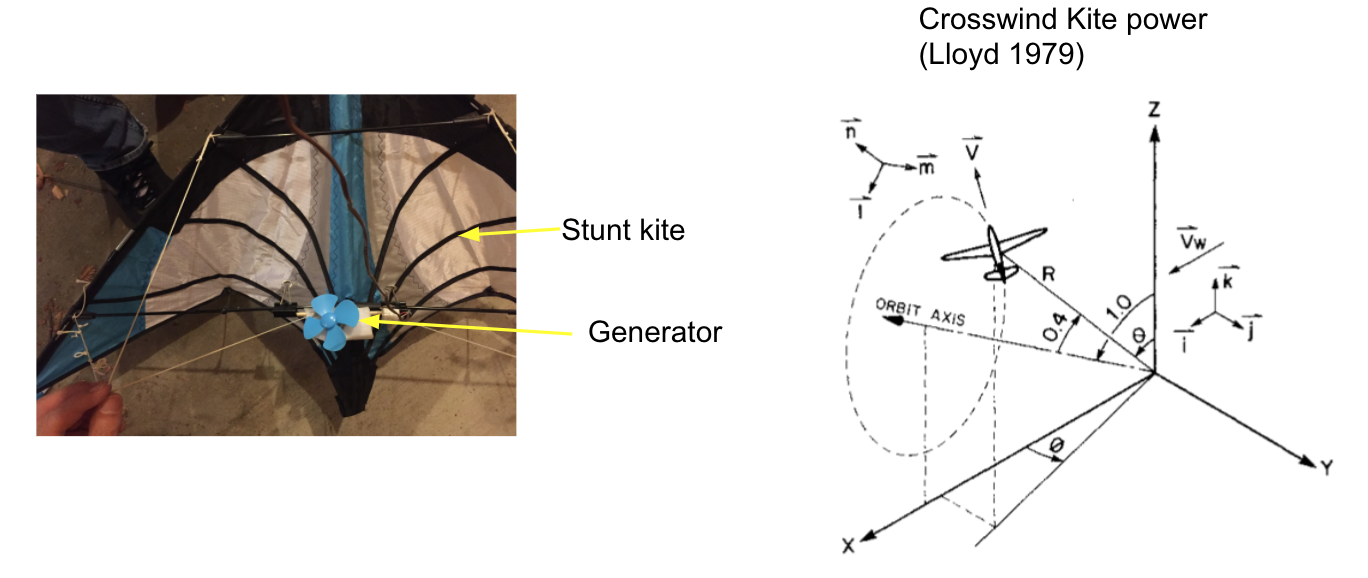
So far, this project has been more of a quick-and-dirty proof-of-concept than an engineering novelty (I quite literally mounted a windmill onto a kite, which wasn’t the most efficient). These results are very preliminary, but I’m excited by the potential for development in using kits to harness higher-atmosphere wind power, especially with strategy improved beyond the crude and straightforward design I used this time.
 Ponderings from a making enthusiast